



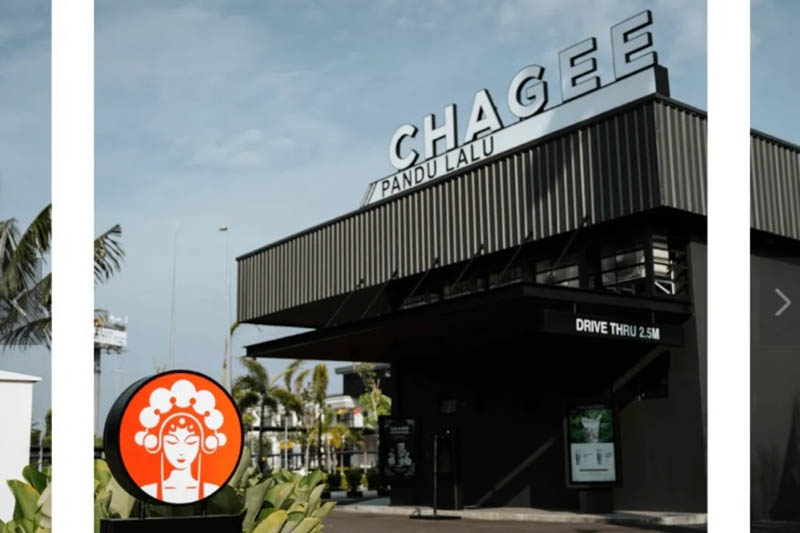
Chagee, which has been rapidly expanding domestically, is now accelerating its store openings overseas.
In April, Chagee opened its first store in Indonesia; in May, it entered North America with its first US store, and opened three new stores in Thailand; in June, it simultaneously opened 8 stores in Malaysia...
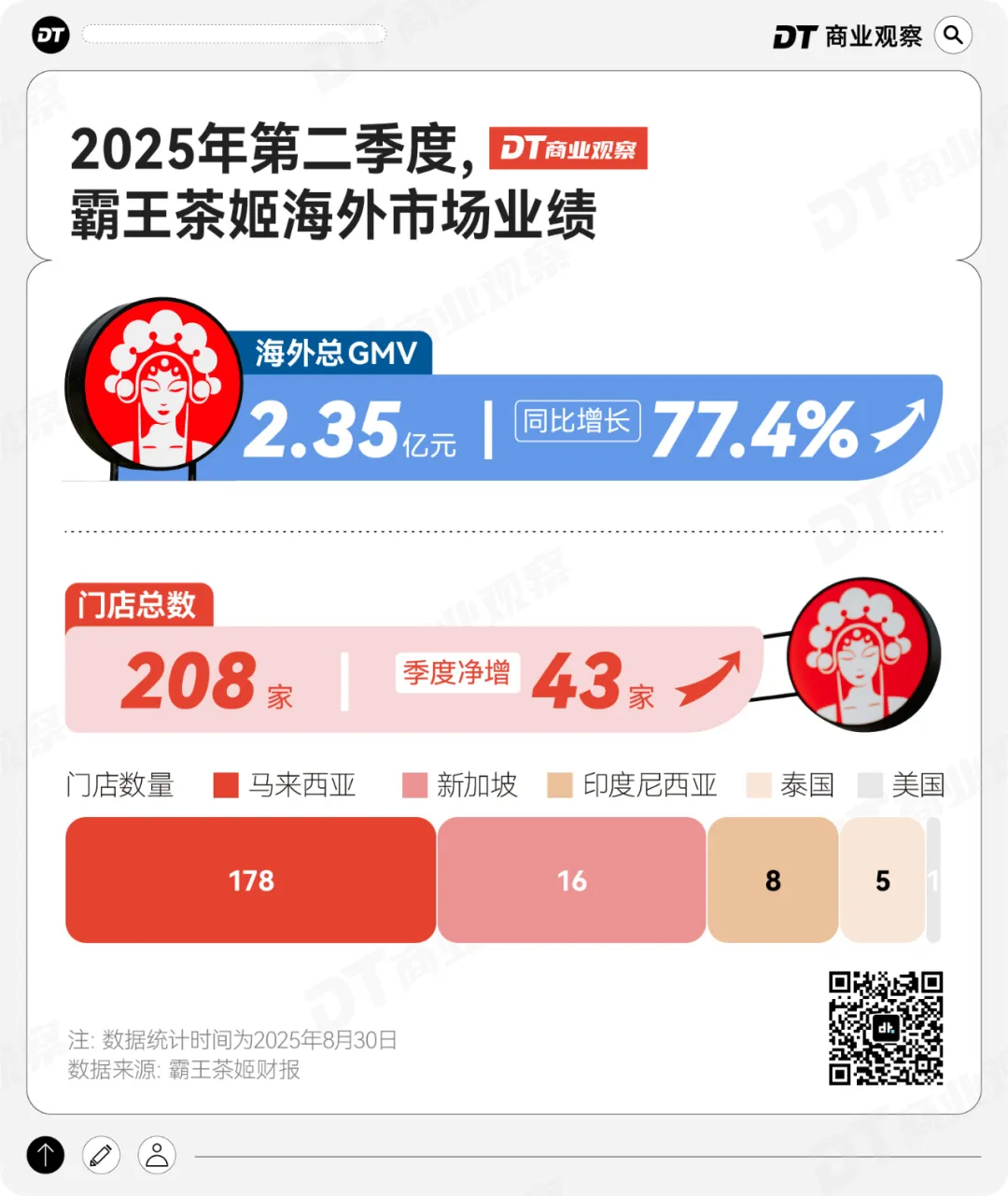
Last week, Chagee released its second-quarter financial report. Data shows that in Q2 this year, Chagee's total number of overseas stores reached 208, with a net increase of 43 stores in the quarter. As of June, Chagee's overseas stores cover Malaysia (178 stores), Singapore (16 stores), Indonesia (8 stores), Thailand (5 stores), and the United States (1 store).
The performance of overseas stores is also impressive, with total GMV for overseas stores this quarter reaching 235 million RMB, a year-on-year increase of 77.4%.
The overseas expansion of new tea beverages is not new, but how is Chagee's approach different? What brand strategy is reflected behind the soaring performance? "DT Business Observation" has compiled the following analysis based on the financial report.
From Product to Brand, "Localized" Expression
New tea beverage brands often face a problem when expanding overseas: overseas consumers have different perceptions and consumption habits regarding milk tea compared to domestic ones. When Chagee first expanded overseas, it found that Malaysian preferences still centered around the "bubble tea" series; while in the United States, people are more accustomed to and frequently consume "coffee" as their beverage of choice.
How to make overseas consumers accept a relatively unfamiliar Chinese tea?
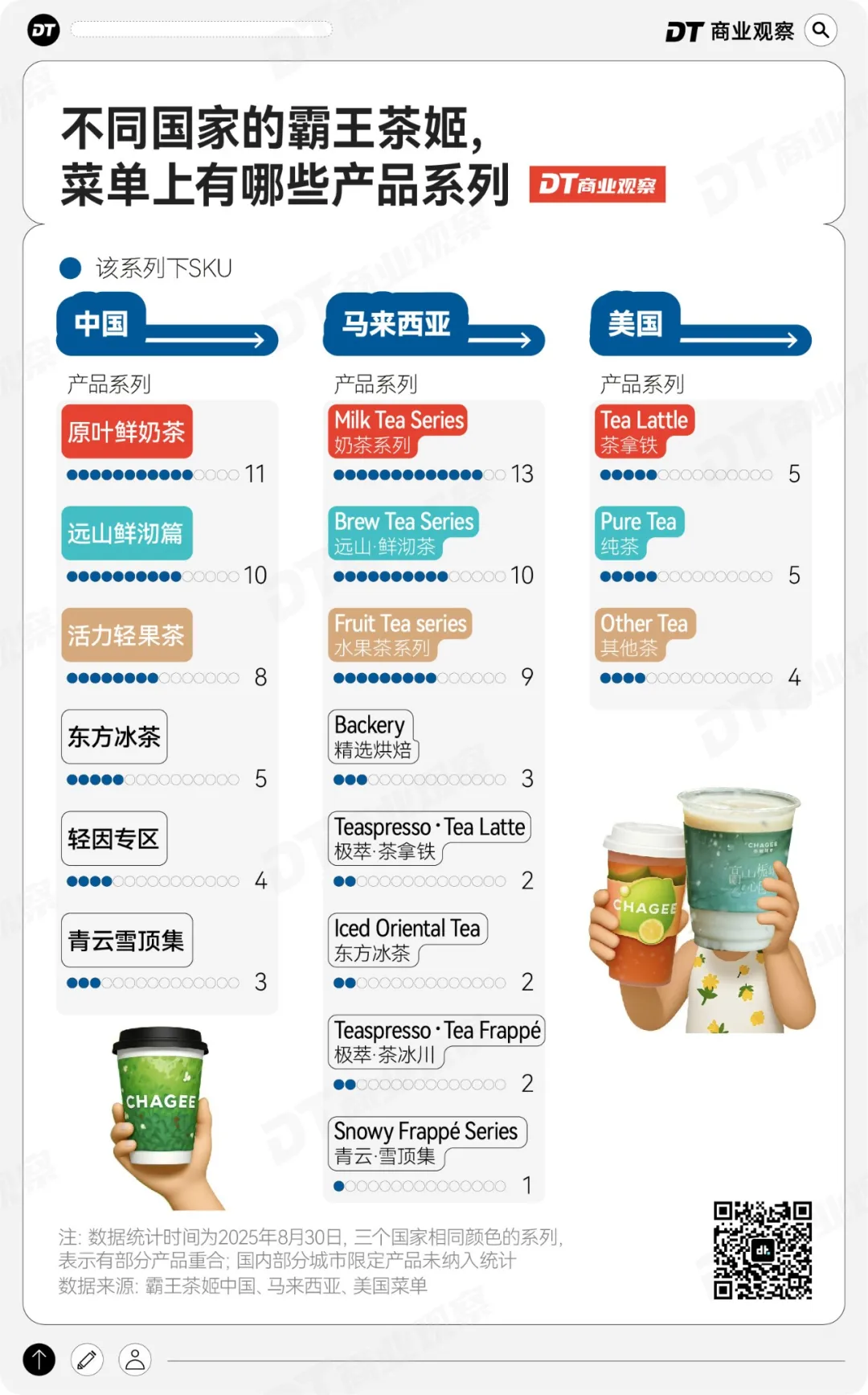
By comparing Chagee's menus in China, Malaysia, and the United States, we found that Chagee differentiates its products across different regions.
Just as some Chinese people "can't sleep after drinking tea," leading Chagee to introduce a "low-caffeine section," the Malaysian menu also has some "regional exclusives"—
"Grain Fragrance Roasted Tea" sold out in major Malaysian cities within two weeks of launch and is also a phenomenal hit in the Southeast Asian market; "Yinshan Matcha" is a special product launched by Chagee to celebrate its sixth anniversary in Malaysia.
The current menu in the US market is relatively streamlined, currently only featuring three major categories: Tea Latte (which is the domestic original leaf fresh milk tea), Pure Tea, and Other Teas, with a total of 14 SKUs.
Currently, Chagee has established respective product R&D teams in the Asia-Pacific market, which will develop new products suitable for local conditions based on different countries.
Of course, food and beverage are often tied to a country's culture, so when F&B brands expand overseas, in addition to product export, they also need to integrate tea culture with local culture.
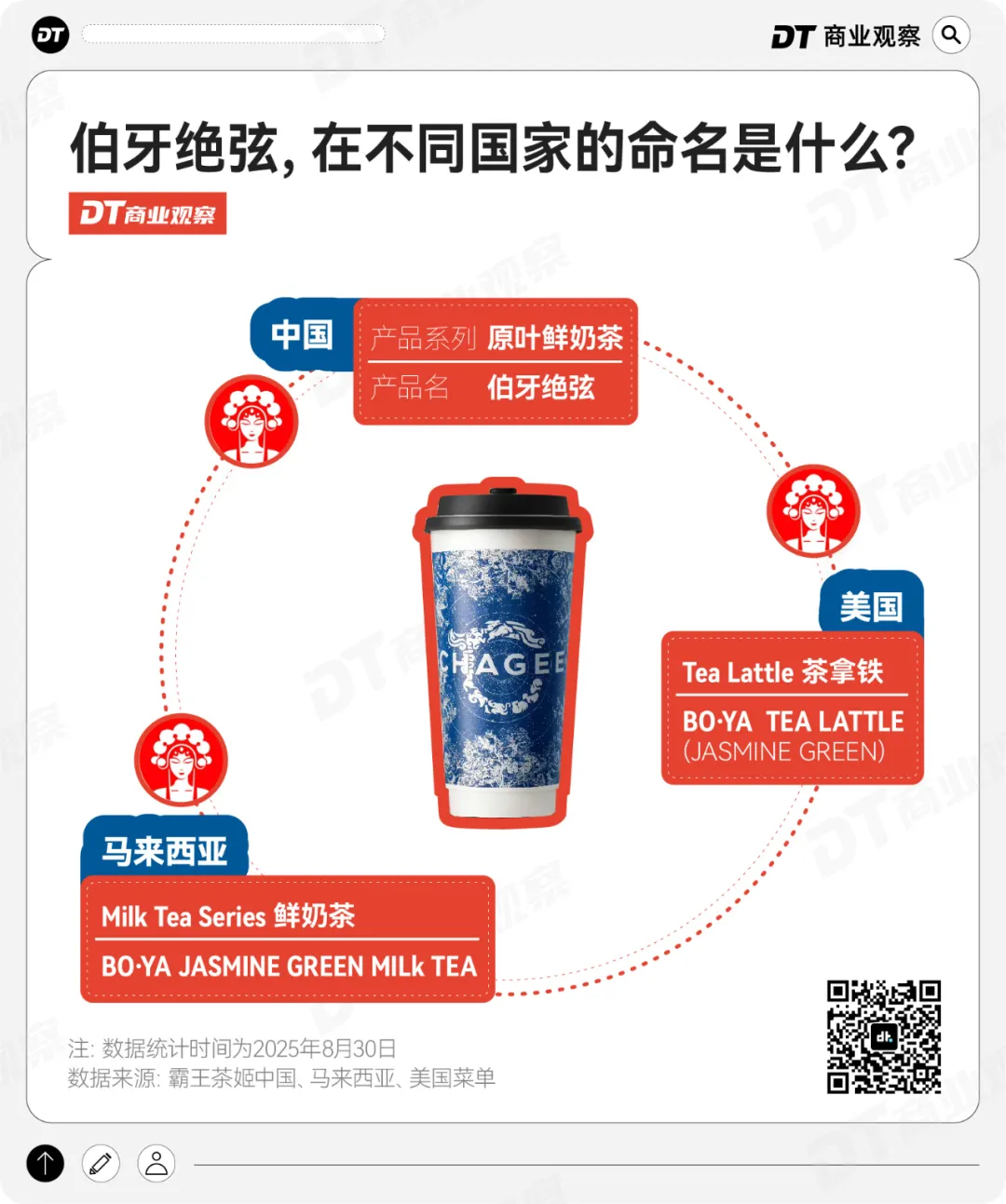
Take Chagee's flagship product "Boya Juexian" as an example. Its essence is jasmine green tea + fresh milk. To help overseas markets understand "what is original leaf fresh milk tea, what is Boya Juexian," Chagee has put considerable effort into product naming.
In Malaysia, Chagee categorizes Boya Juexian under the "Milk Tea" series, with the English name "BO·YA JASMINE GREEN MILK TEA," which directly translates to "Boya·Jasmine Green Milk Tea," retaining "Boya" while directly informing consumers about the ingredients of this milk tea.
But on the US menu, Boya Juexian is placed in the "Tea Latte" product series, with the product name "BO·YA Tea Latte." This translation method allows American consumers to understand from the analogy of latte (coffee + milk) that Boya Juexian is a tea + milk product.
To better promote Boya Juexian, in May this year, Chagee also integrated the production process of its star product "Boya Juexian" with the weaving technique of Malaysian intangible cultural heritage "Songket," interpreting the inclusiveness of "tea" as a medium for cultural dissemination.
From the small details of product naming to various marketing activities, these actions have not only made Chagee's products sell out but have also conveyed Eastern "tea culture" overseas.
One statistic is that in the United States, over half of consumers choose reduced-sugar or sugar-free tea beverages. Additionally, pure tea products are also very popular in the US, with many local consumers viewing pure tea as a substitute for coffee.
From Employees to Partners, "Localized" Operations
In addition to "adapting to local conditions" in product development and marketing methods, F&B companies also face tests of "internal capabilities" when expanding overseas: supply chain construction, local team building, international talent introduction...
"DT Business Observation" found that in every new overseas market, Chagee's operational strategy shares similarities with the international expansion of two giants: one is Starbucks, and the other is McDonald's.
First, let's see how the predecessor giants did it.
When Starbucks first entered China, Chinese people neither drank coffee nor had heard of "Starbucks." Therefore, Starbucks adopted a "regional licensing" model, establishing joint ventures with local leading enterprises in North China, East China, and South China respectively. These leading enterprises had a better understanding of the Chinese market and could provide more resources for Starbucks, while Starbucks was mainly responsible for brand and standard output.
After Starbucks gradually gained a foothold in China, it slowly regained equity and transitioned to full direct operation.
When McDonald's first entered China, it partnered with Sanyuan, then briefly operated solely before feeling that development was slow. In 2017, it reached a strategic cooperation with CITIC Limited, CITIC Capital, and The Carlyle Group, since when McDonald's entered the "Golden Arches era."
Now, Chagee is also "leveraging local giants" in this way to achieve "powerful alliances"—
In Malaysia, Chagee has reached a strategic cooperation with the hotel industry giant Lian Da Group, planning to open 300 stores in Malaysia in the next three years. In Indonesia, Chagee established a joint venture with PT Era Boga Nusantara, a subsidiary of local retailer Erajaya. Erajaya also has partnerships with companies like Xiaomi, Huawei, and XPeng. In Thailand, Thai President Beverages Company Limited has invested in Chagee (Thailand) Company Limited.

Although already partnered with local giant enterprises, Chagee is actually very "cautious" in its overseas store expansion.
Different from some F&B enterprises that use supply chain output + franchising to rapidly "claim territory and expand scale" in a short time, Chagee, upon entering each new market, first verifies product acceptance and the single-store model by opening directly operated stores, then opens multiple joint-operated stores. Only after the above stores are validated by the market will it further attract more franchisees to join.
Precisely because of this, overseas stores can achieve scale growth while having better profitability than the previous quarter. Even in the competitive overseas tea beverage market, Chagee has achieved a slight price increase.
The introduction of senior international talent is also a highlight of Chagee's overseas business.
During the analyst conference call, Chagee also announced the core management team for the North American market: Emily Chang (Chief Commercial Officer, North America), Aaron Harris (Chief Development Officer, North America).
The former previously served as CEO of McCann Worldgroup China, Chief Marketing Officer of Starbucks China, and Chief Commercial Officer of InterContinental Hotels Group; the latter served as Senior Vice President of Development at Dutch Bros Coffee.
In May this year, Chagee's first North American store opened in Los Angeles, USA, setting a record of 5,000 cups sold in a single day, and still maintains an average daily sales level of 1,000 cups. In August, the second US store began trial operations.
What does overseas expansion mean for Chagee?
From the perspective of industry development trends, overseas expansion is an "inevitable" path for tea beverage brands seeking growth.
Domestically, whether it's tea beverage brands, category development, flavor innovation, or price ranges, it can be described as "a hundred flowers blooming."
According to iiMedia Research, after rapid growth, the new tea beverage market size is now gradually slowing down. The year-on-year growth in 2023 was 13.5%, dropping to 6.4% in 2024, and future growth rates will be even slower, while overseas markets offer broader opportunities.
The overseas expansion of new tea beverages is not something that only started in recent years. Before 2017, "bubble tea" brands represented by CoCo, Gong Cha, and Tiger Sugar successively ventured overseas for trials, regarded by the industry as the first wave of new tea beverage overseas expansion.

After 2018, the second wave of overseas expansion began, with brands like Heytea, Nayuki's Tea, Mixue Bingcheng, and Chagee expanding overseas in clusters.
In the second wave of overseas expansion, Southeast Asia was the "first stop" for most brands. The reasons are understandable: Southeast Asia not only has a hot climate with high demand for iced drinks, but its culture is also relatively close to China's. iiMedia Research predicts that from 2023 to 2028, the compound annual growth rate of freshly-made beverages in Southeast Asia will be as high as 19.8%, far exceeding the global average of 7.2%.

After 2024, more tea beverage brands have set their sights on economically developed regions in Europe and America. Heytea entered France, Chagee entered the United States, Cha Bai Dao entered Spain, and Jasmine Milk White entered the UK.
Although Europe and America have greater differences in culture and consumption habits, they offer market gaps, high consumption power, and broad potential markets.
From the perspective of brand positioning and long-term development strategy, Chagee's overseas expansion is also inevitable.
Chagee actually targeted the international market very early—the brand was just established in 2017, it set up an overseas business department in 2018, and opened its first overseas store in Southeast Asia in 2019. During the same period, Chagee was still mainly opening stores in the Yunnan-Guizhou-Sichuan region domestically, without nationwide expansion.
Another argument is: Chagee's stores in various overseas countries are not located in Chinatowns with high Chinese populations, nor do they follow a "cost-performance route." Instead, they open stores in core business districts of major cities, with some stores adjacent to international brands like Starbucks and McDonald's, following a high-end route.
In Malaysia, the price of a large cup of Boya Juexian is 13.9 Malaysian Ringgit, converted to approximately 23.4 RMB; the US pricing is 5.75 USD, converted to approximately 41 RMB.
This means Chagee must have sufficient product and brand confidence to make overseas consumers willing to pay for a not-so-cheap "Chinese tea."
Now, Chagee has gradually found the path to leap from a "Chinese brand" to a "global brand": not simple store expansion, but the integration of products, supply chain, marketing methods, and local culture, making the brand a cultural symbol of "modern tea."