
NEWS & EVENTS

-
HOME > NEWS > Industry News
Chinese tea and coffee brands “going global”—who will become a “global brand”?
2025-09-01
As mentioned in previous articles, in the food delivery platform wars this year, the originally low-key Heytea couldn't resist joining the fray and fully launched on the Taobao Quick Buy (Ele.me) platform, aiming to tap into more domestic incremental markets.
Another tea beverage giant, Chagee, represents a different approach in this battle.
Chagee's financial report released last week showed that in the second quarter of this year, its average monthly GMV per store in Greater China was 404,350 yuan, with same-storeGMV decreasing by 23% year-on-year. Chagee's global CFO Huang Hongfei explained this was mainly due to two factors: on one hand, the comparison is against the exceptionally strong second-quarter data of 2024; the other is the intensified price war on food delivery platforms. Chagee chose not to participate in short-term-oriented discount campaigns, which also led to a temporary diversion of some customers, affecting its sales performance.
We also noted that on the very same day, Chagee's founder, chairman, and global CEO Zhang Junjie for the first time announced a new North American core management team: appointing Emily Chang as North America Chief Commercial Officer (she officially joined Chagee in June this year, previously served as Chief Marketing Officer of Starbucks China); Aaron Harris was appointed as North America Chief Development Officer, having previously served as Senior Vice President of Development at Dutch Bros Coffee.
Image source: Internet
In May this year, Chagee's first North American store officially opened in Los Angeles, USA. In August, its second US store began trial operation. The cross-industry experience of the two newly announced executives in food and beverage, tech retail, advertising, and other fields, along with their deep franchise business operation backgrounds, suggests ambitions to make a significant impact in the North American market.
In fact, including Chagee, more and more Chinese tea and coffee brands have recently embarked on "global navigation." In the second quarter of 2025, Chagee's overseas stores increased from 169 in Q1 to 208, a net increase of 39. Mixue Bingcheng already has over 5,000 stores in 12 countries; CHABAIDAO has entered South Korea and European markets; Cotti Coffee and Heytea have successively expanded into the North American market; even the lower-tier brand Ningji signed 15 stores in Southeast Asia in the first half of the year.
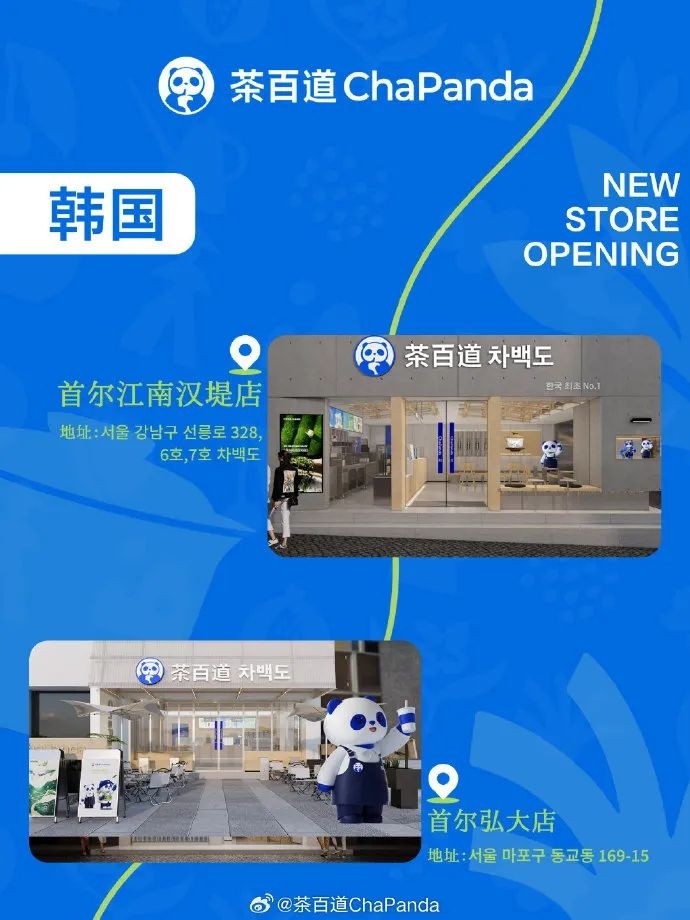
Image source: Internet
On overseas social media, Chinese-style beverages have become a new trend for some young overseas consumers to experience and share. They not only "pay for it" but also gladly "check-in." The trend looks promising. However, on the path to becoming a "global brand," Chinese brands still have a considerable journey ahead.
Digitization and Supply Chain Become the "Twin Engines"
Regarding the reason for going overseas, a Chagee representative once said in media interviews, "It was a decision to embrace opportunities." Tea and coffee are the two major beverages of the world, but in the freshly-made tea industry, there hasn't yet been a global tea beverage brand. Furthermore, back in 2017, from its very founding, Chagee proposed its ambition to "expand to 100 countries".
He also stated that after Chagee's listing on NASDAQ this year, he hopes that through the brand's modern interpretation, it can invigorate tea, a beverage with a long history and widely loved by consumers worldwide, aiming to "connect everyone daily with a cup of tea."
Looking at their overseas expansion layout, it becomes clear that the overseas stores of Chinese tea and coffee brands are mostly concentrated in Southeast Asia, which has also essentially become their first stop in going global.
Data from Euromonitor International's latest report, "The Rise of Chinese Brands in Southeast Asia," shows that the market value of specialist coffee and tea shops in Southeast Asia reached USD 4.7 billion in 2024 and is projected to grow at an annual rate of 9% until 2029. Chinese companies have been at the forefront of this expansion: between 2019 and 2024, the number of stores for Mixue Bingcheng and Chagee in Southeast Asia increased by 80%.
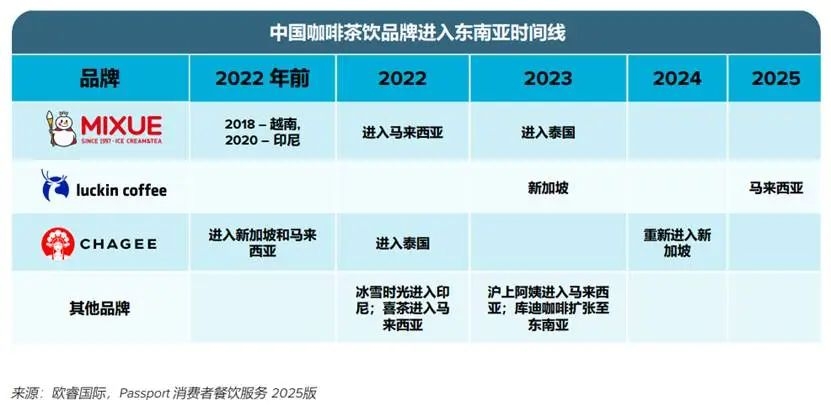
Data from Ries Strategy Consulting's report, "Chasing Dreams in Southeast Asia — Research Report on Overseas Expansion of Freshly-made Beverage Categories," also shows that compared to Taiwanese bubble tea having many stores in Europe and America, mainland new tea brands focus their overseas market expansions primarily on Southeast Asian countries. For instance, Mixue Bingcheng's stores are concentrated in Vietnam (> 1,300 stores) and Indonesia (> 2,600 stores); Chagee focuses its core efforts on Malaysia (> 130 stores); while Heytea was among the first to target Singapore (7 stores).
Industry insiders analyze that Southeast Asia has become the "beachhead" for Chinese tea and coffee brands' overseas expansion mainly because it possesses a vast and young consumer base, a rapidly growing economy, and shares certain cultural similarities with China, leading to high consumer acceptance of tea beverages and coffee. Euromonitor International shows that Luckin Coffee and Mixue Bingcheng currently have a leading performance in the Southeast Asian market.
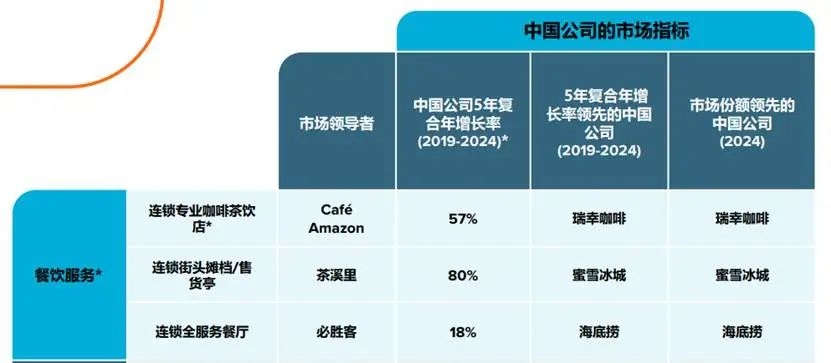
Image source: Internet
However, as the Southeast Asian market gradually becomes saturated, an increasing number of Chinese brands have started to shift their focus to the European and American markets.
At the end of June, Luckin Coffee opened two stores in New York. Previously, most American consumers were unfamiliar with this Chinese brand, but after trying it, many became very interested in its original cold brew; others expressed on social media a preference for its Iced Coconut Latte, believing its quality "can completely rival Starbucks." More importantly, Luckin Coffee's price range in the US is $3.45 to $7.95, and new users can enjoy discounts after downloading the App, offering a much higher value for money compared to Starbucks.
Luckin Coffee's entry into the United States also represents a challenge to the traditional, mature coffee market. Unlike competing with local brands like Café Amazon and Zus Coffee in the Southeast Asian market, it now faces a different consumer base and established brand barriers.
How can Chinese tea and coffee brands "ride the waves" in overseas markets? Digital capabilities and supply chain efficiency may serve as the "twin engines."
Take Luckin Coffee as an example. It entered the Singapore market in March 2023 . As of the second quarter of this year, it had opened 63 company-owned stores. By collaborating with local suppliers, Luckin Coffee ensured a stable supply of raw materials like coffee beans and milk. It also launched specialty drinks, such as the Pandan Latte, catering to local taste preferences.
Luckin exports its well-honed operational system from the Chinese market as a whole: self-service ordering, contactless pickup, integration with local payment systems; a fully digitalized process can reduce trial-and-error costs.
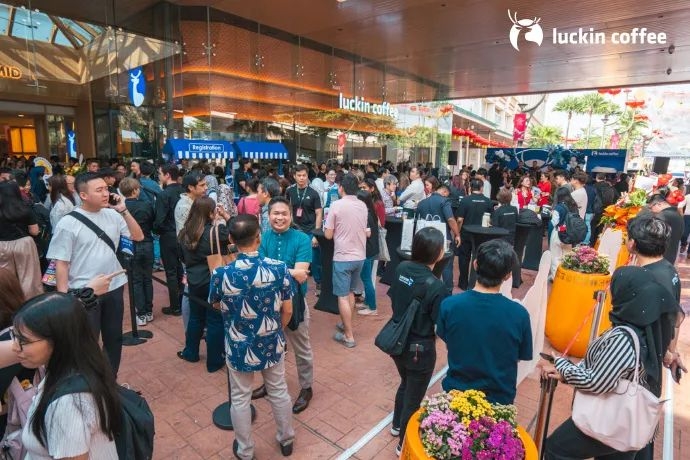
Image source: Internet
Furthermore, by leveraging platform-based dynamic scheduling, Chinese companies can achieve quality replication and cost control on a global scale. Behind each cup of coffee or tea lies a supply chain network that is expanding worldwide.
The supply chain can also serve as a "moat" for Mixue Bingcheng. External materials show that Mixue Bingcheng was the earliest enterprise in China's freshly-made beverage industry to establish a central factory. It possesses a comprehensive, end-to-end supply chain system covering key aspects such as procurement, production, logistics, research and development, and quality control. This enables the provision of competitive, one-stop solutions to franchisees. The core beverage ingredients supplied to franchisees are 100% self-produced, which not only effectively controls production costs but also better ensures synchronized product quality.
Examining Mixue Bingcheng's procurement list is like looking at a world map, including milk powder from New Zealand, cocoa powder from Ghana, grapes from Spain, passion fruit from Vietnam, lemons from Chongqing, etc. The massive procurement scale also enables Mixue Bingcheng to purchase many core raw materials at prices below the industry average.
It is reported that in 2023, its lemon procurement volume reached 115,000 metric tons. Through centralized procurement and direct supply from origin regions, Mixue Bingcheng reduced its lemon procurement cost by 25%. Even during the surge in domestic lemon prices in 2022, its end products saw no price increase.
At the end of May this year, we spoke with Wang Jie, the founding partner of Ningji. She also mentioned, "In our five-year overseas strategy plan, we particularly emphasized the importance of the supply chain. In the first two years, we will focus on building the supply chain, as its stability is crucial for a brand going global." According to Wang Jie, Ningji's overseas expansion "is not just about opening stores overseas, but also a systematic export of supply chain and digital intelligence capabilities."
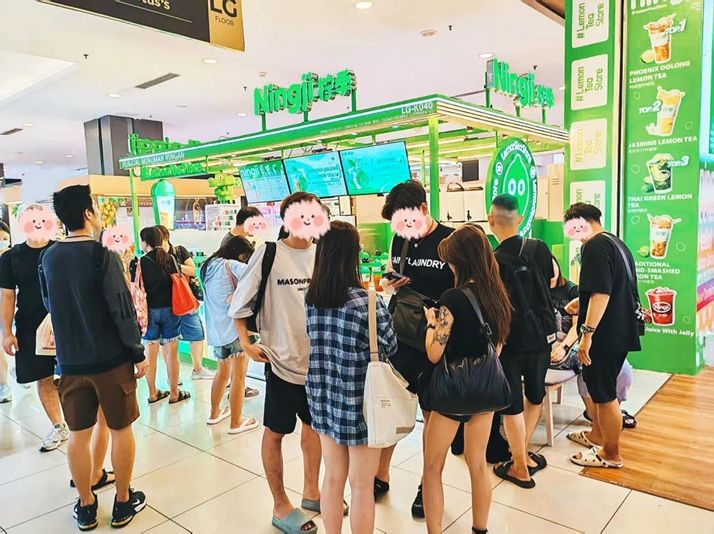
Image source: Internet
Localized Operations and Cultural Export
To become a brand recognized by local consumers overseas and thus a global brand, it is also essential to execute localized operations precisely while skillfully integrating and exporting cultural elements based on the local context.
Mixue Bingcheng formulates corresponding development strategies based on the market characteristics of different countries and regions. For example, in its Bangkok, Thailand stores, besides classic ice cream and milk tea, it has launched Thai-style milk tea and durian milkshakes featuring local flavors, with store decor incorporating Thai elements. In Vietnam, it considers adding dine-in space and launching customized flavors like pineapple lemongrass. During its trial operation in Kazakhstan, it did not actively promote specific products to customers but instead let local consumers vote to select their "signature products."
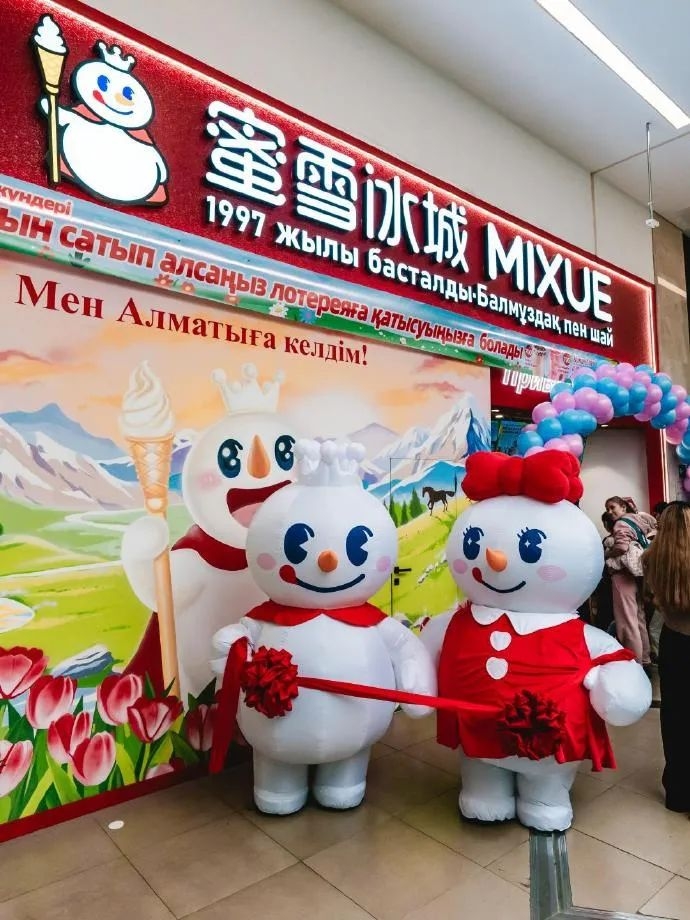
Image source: Internet
Chinese beverage brands are considering no longer being fixated on market education, but instead lowering the acceptance barrier for consumers through familiar flavors, then gradually building a sense of identification through brand storytelling.
In the Southeast Asian market, where consumers are more price-sensitive, the strategy may focus on high-value-for-money products and increase brand awareness through large-scale store openings. In markets like Japan and South Korea, where consumers have higher demands for quality and taste, Mixue Bingcheng would optimize product formulations, launch products better suited to local palates, and pay attention to store design and service.
Chagee also places great emphasis on localized operations. In Malaysia, it launched the "Nyonya Lychee Melon," combining pandan leaves from Nyonya culture with lychee and melon; in Thailand, it introduced the "Thai Longan Coconut," using the local specialty fruit longan, paired with coconut milk jelly and a jasmine tea base.
Beyond product flavors, Chagee has also innovated its store spaces with localization. In Malaysia, stores incorporate elements of Baba-Nyonya culture like tiles and carvings; in Singapore, stores feature Nanyang-style shutters and patterned tiles, creating a unique spatial atmosphere.
Heytea's approach in London, UK, uses the model of "Chinese-style stores + social attributes" to create a viral effect, hoping to attract local young people to be interested in queuing up to buy milk tea with a Chinese-style logo, and share photos on social media.
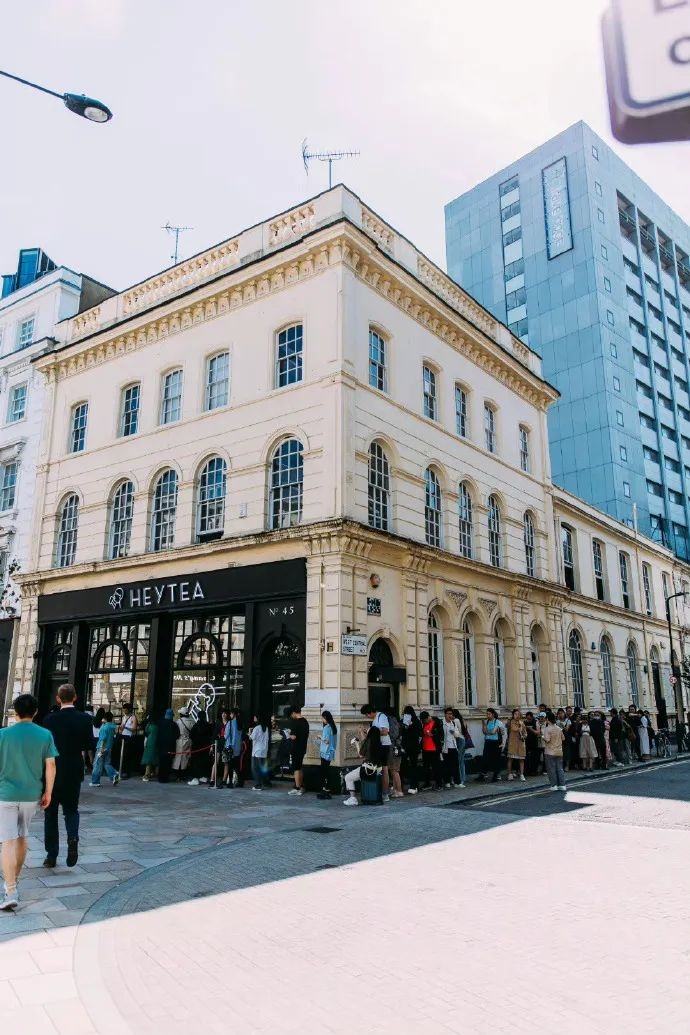
According to Heytea, "We hope to convey Chinese culture to the world through tea beverages." Therefore, the design of its overseas stores intentionally incorporates traditional Chinese cultural elements such as calligraphy and paper-cutting, creating a unique Chinese atmosphere. This approach ultimately achieves brand association by connecting with uniquely Chinese genes and memories.
In fact, Chagee has also adopted similar measures, telling the story of Chinese tea beverages and strengthening the cultural symbol of "Oriental Tea Drinks" through packaging design, cultural experience activities, etc. For example, the cultural crossover event "CHAGEE × Museums" held at the National Museum of Malaysia, which combined Chinese tea culture with Malaysia's multiculturalism, also attracted many local consumers.
If overseas consumers cannot fully understand and identify with the brand and product culture, subsequent progress will be extremely difficult. Ningji also explored the North American market, but their first trial store in the US did not sell its most famous domestic lemon tea series. Instead, it focused on bubble tea products because Ningji believed this "better aligns with local consumer tastes".
Ningji's overseas expansion strategy "integrates considerations of local climate, temperature, logistics, warehousing, talent teams, and other factors. First, deeply cultivate this city and region, then steadily penetrate the surrounding areas." Wang Jie stated that from raw material cultivation and product R&D to store operations and brand communication, as Ningji's overseas footprint expands and the brand develops, its mature domestic brand expansion model can then be adapted and replicated within its overseas expansion strategy.
We hope that in the near future, whether on the streets of Southeast Asia or in major Western cities, we can frequently see young people holding milk tea and coffee cups from Chinese brands (preferably with Chinese logos). A beverage can become a cultural symbol, no longer a pure imitator but potentially a definer of new industry standards. By then, it will not be too late to say we have our own "global brands."